
Knowledge · Clone Files Checker
How to Find and Delete Duplicate Files on Windows
Downloads and Documents fill the same way. A PDF saved twice. A video sitting next to Copy of the same video. A zip the browser saved again with (1) in the name.
A duplicate file finder on Windows groups those copies so you can keep one file and remove the rest.
Direct answer: Windows 11 does not include a duplicate-file finder. File Explorer can sort and search by name or size. Storage Sense clears temporary files. Neither compares the contents of files across folders. PowerShell can confirm that two files match. When the mess is a folder of PDFs, videos, archives, and downloads, Clone Files Checker File Search groups those copies, lets you keep one, and moves the extras.
Key takeaways
- There is no Windows setting that finds duplicate files.
- The same name or the same size is a clue. It does not prove the files match.
Get-FileHashcan confirm content for files you already suspect. It does not preview a group or choose a keeper.- Clone Files Checker scans the folders you pick and groups content matches.
- Move extras first. Delete in this app removes the checked files from disk.
- Similar photos, and files that live only in Google Drive, are different jobs.
Why the same file shows up twice
Copies rarely live in one folder named Duplicates. Common sources:
- The browser downloads the same PDF, installer, or zip again and adds
(1). - Copy and paste creates
Copy of. - A backup folder sits beside the folder you actually use.
- The same video is on the PC and on a USB drive or an external disk.
- OneDrive keeps a local copy next to a file you also saved somewhere else.
Compare methods
| Method | Best for | Compares file content? | After you find a copy |
|---|---|---|---|
| File Explorer sort / search | A small folder, obvious (1) or Copy of names | No | Delete sends the extra to the Recycle Bin |
PowerShell Get-FileHash | Confirming two files, or a small folder you name | Yes | You still delete by hand in Explorer |
| Storage Sense | Temporary files, large files, unused files | No | This is storage cleanup, not a duplicate scan |
| Clone Files Checker File Search | PDFs, videos, archives, and mixed folders | Yes, for files that share a size | Review the group, then Move or Delete |
Use Explorer when you can already see the copy. Use a scanner when the same file has a new name, or when it sits in more than one folder.
Method 1: Spot obvious copies in File Explorer
This is the built-in path. It does not detect duplicates. It makes the obvious ones easier to see.
- Open File Explorer and go to Downloads, Documents, or the folder you suspect.
- Switch to Details.
- Sort by Name, then by Size.
- Look for
(1),Copy of, or two files with the same size and a near-identical name. - Open both if you are unsure. Keep one. Press Delete so the extra goes to the Recycle Bin.
What this is good at
- A handful of files in one folder.
- No extra software.
Limits
- A different filename hides the same PDF or video.
- The search only shows the folder you are in.
- Matching size is a hint. Two different files can share a size.
Method 2: Confirm a match with PowerShell
Windows PowerShell includes Get-FileHash. Microsoft’s documentation describes it as a way to compute a hash of a file’s contents, so you can tell whether two files match even when the names differ. The cmdlet reference is Get-FileHash.
Use it on two files you already have side by side, or on a small folder. Read the paths it prints. Delete the extra in File Explorer so the Recycle Bin still has it.
Limits
- There is no preview and no “keep the oldest” rule.
- A script pointed at a whole drive is easy to misread.
- This is a check, not the everyday way to clean Downloads.
Method 3: Scan folders with Clone Files Checker
Clone Files Checker is Sorcim’s Windows and Mac app for exact duplicate files. This article is the Windows workflow. The download page lists Windows 11, 10, 8.1, 8, and 7.
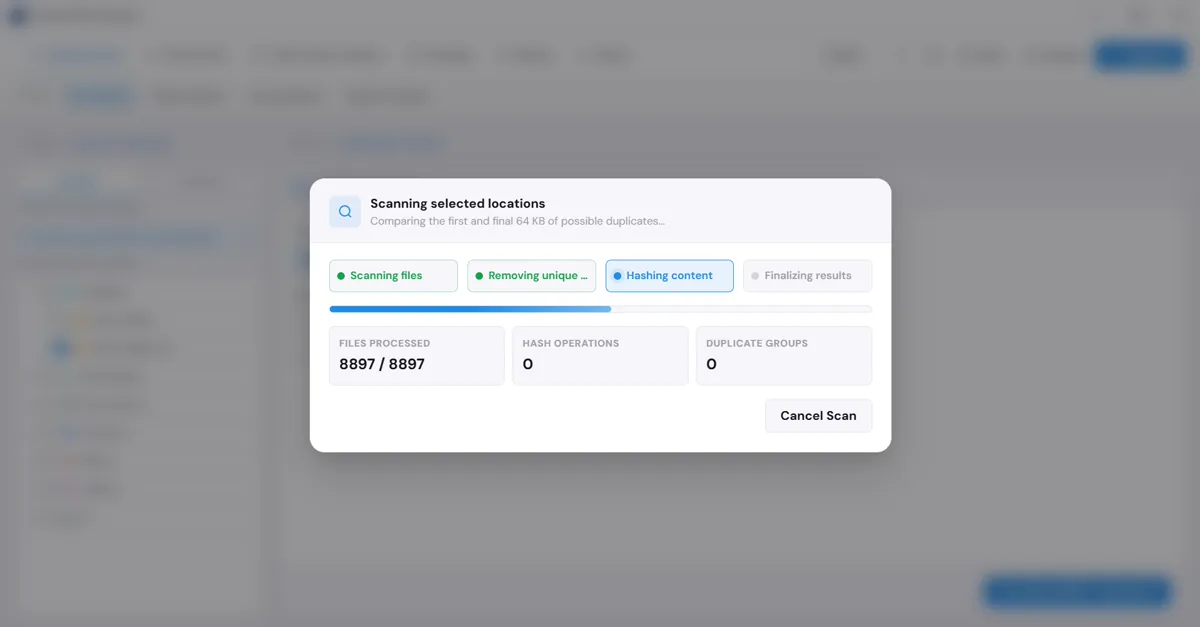
File Search groups files that share a size, then compares a fingerprint of the start and the end of each file. The progress dialog says it compares the first and final 64 KB. Files with a unique size never reach that step. Treat the groups as content matches to review. This is not a full-file forensic compare.
There is no similar-photo mode on this desktop app. Bursts and resized pictures stay with PictureEcho.
How to find duplicate files on Windows with Clone Files Checker
Counts, sizes, and dates in the screenshots are one scan. They are not a typical result.
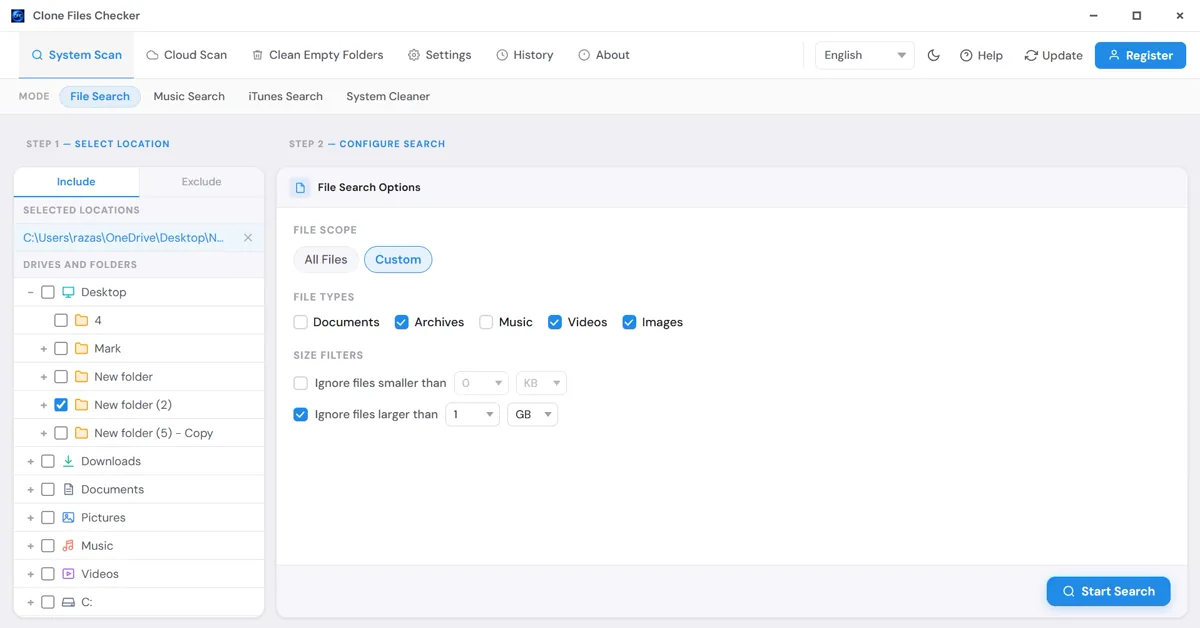
1. Choose the folders and file types
- Install Clone Files Checker and open System Scan.
- Leave the mode on File Search.
- On Include, tick the folders you want. Downloads is a good first folder. Windows, Program Files, and the Recycle Bin are already left out.
- All Files scans every type. Custom limits the scan to Documents, Videos, Music, Images, or Archives. Size filters are optional. Leave them off unless you want to skip very small or very large files.
- On Windows, you can right-click a folder in File Explorer and choose Scan with Clone Files Checker. That opens the app with the folder selected. It does not start the scan.
Mapped network drives can appear in the folder tree. A USB drive or an external disk appears when that disk is connected. Tick the folder. The app does not walk a cloud account from this window.
2. Start the search
- Click Start Search.
- If a previous result is still saved, choose Load Last Scan Result or Start New Scan.
- Wait through the stages: scanning files, removing unique sizes, hashing content, and finalizing.
- Open the results when the scan finishes.
3. Keep one file in each group
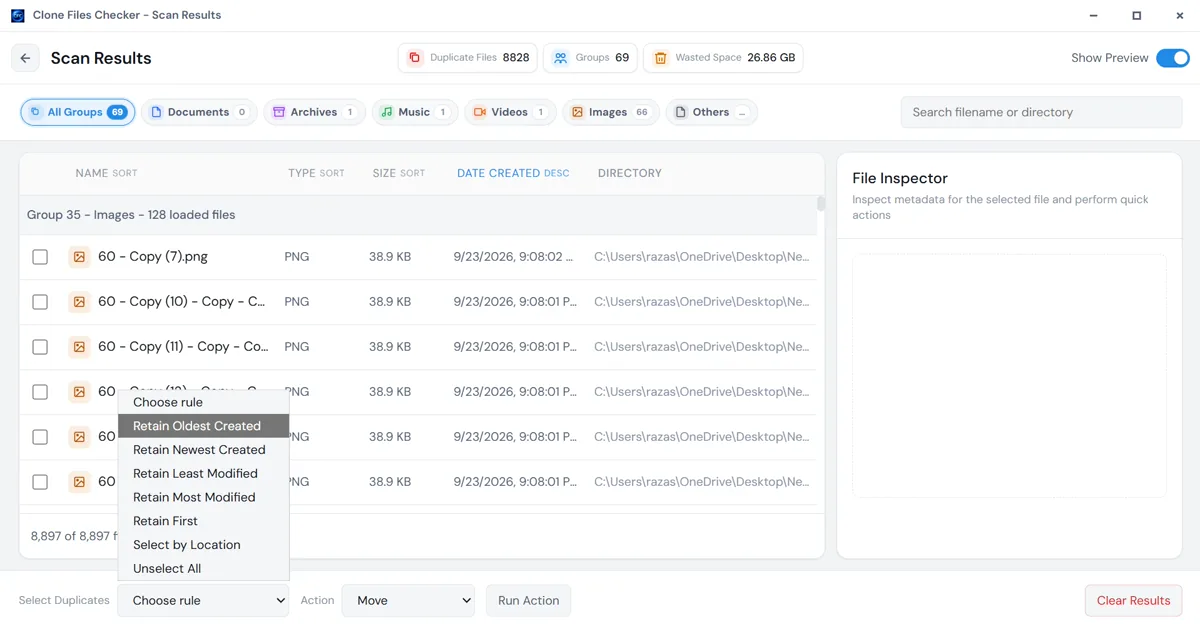
- Use the type pills when you only want Documents, Archives, Music, Videos, or Images.
- Open a group. Turn on Show Preview and use File Inspector when you need to see the file. Open File or Show in Explorer if the preview is not enough.
- Click Select Duplicates, then Choose rule. The rules are Retain Oldest Created, Retain Newest Created, Retain Least Modified, Retain Most Modified, Retain First, and Select by Location.
- A retain rule leaves one file in the group unchecked and checks the others. Open that keeper before you continue.
- Select by Location checks files in a folder you pick, and it can check the copy you meant to keep. Read the checks.
- Select All can check every visible file, including every copy in the group. Use a retain rule, then spot-check.
4. Move the extras, or delete only what you have checked
- Set Action to Move. Click Run Action and pick a folder. The checked files leave the scanned folder and sit where you sent them. Open that folder before you delete anything.
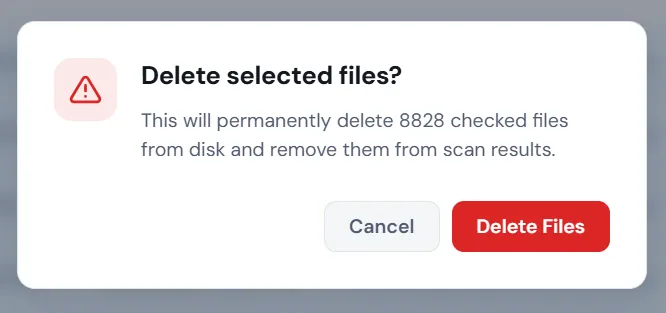
- Delete asks you to confirm, then removes the checked files from disk. They do not go to the Recycle Bin.
- The free scan can move or delete up to 10 duplicate groups. Cleaning more groups needs a license. The price is on the live register page.
- History lists completed move and delete batches. It is a log. It does not put the files back.
What this scan is, and what it leaves alone
| Job | Where it belongs |
|---|---|
| PDFs, videos, zips, and mixed Downloads on the PC | Clone Files Checker File Search |
| Photos that look alike, bursts, and resized exports | Duplicate photos on Windows |
| Google Drive, Dropbox, or OneDrive in the browser | Cloud Duplicate Finder, a separate web app |
| Duplicate files on a phone | Clone Files Checker for Android, a different app |
| Big, old, or unused files that are not copies | System Cleaner inside this app. That pass does not look for duplicates |
The Cloud Scan tab does not connect Google Drive, Dropbox, OneDrive, Box, or Amazon S3. A OneDrive folder that is actually on the PC can be ticked like any other folder. A file that is online-only may fail to hash or to delete.
Music, iTunes, and empty folders
These are separate modes. They are not a second File Search.
- Music Search compares the tags you tick: Title, Artist, Album, Track, Duration, or Bit Rate. File Content is a fallback when a selected tag is missing. Tag matches can group different songs that share a title, so read the group before you remove anything. This scan does not edit a music player.
- iTunes Search reads an iTunes Library XML you choose with Browse. Tracks whose files are missing on disk are skipped. The scan does not edit the iTunes library.
- Clean Empty Folders can remove nested empty folders or only the top level. Restore Empty Folder creates that folder path again. It does not bring back files that used to be inside.
- System Cleaner finds big files, old files, or files that have not been used, when you turn at least one of those rules on. Review that list on its own. It is not a duplicate result.
Safety checklist before you delete
- Start with one folder, such as Downloads.
- Use a retain rule, then open the file that stayed unchecked.
- Move first. Delete only after you have opened the keeper.
- Leave Windows and Program Files out of the scan. They are already excluded.
- In File Explorer, Delete can be undone from the Recycle Bin. In Clone Files Checker, Delete cannot.
- Photos that only look the same belong in the duplicate photos guide.
FAQ
Does Windows 11 have a built-in duplicate file finder?
No. File Explorer sorts and searches. Storage Sense removes temporary files and can surface large or unused files. Neither groups copies by content.
Can File Explorer find duplicate files?
It can show (1) and Copy of when you sort or search. It cannot tell you that two files with different names are the same content.
How do I delete duplicate files on Windows 11 without losing the original?
Keep one file in the group. Move the extras to a folder you can still open. Delete only after you have checked the keeper. In File Explorer, Delete uses the Recycle Bin. In Clone Files Checker, Delete removes the file from disk.
Does Clone Files Checker use the Recycle Bin?
No. The confirm dialog says the checked files will be permanently deleted from disk. Move them first when you want a copy you can still open.
Will this work on Windows 10 as well as Windows 11?
Yes. Windows 10 has the same gap: no built-in duplicate-file finder. The Clone Files Checker download page lists Windows 11, 10, 8.1, 8, and 7. The steps above are the Windows app.
Can Clone Files Checker find similar photos?
No. File Search groups content matches. Bursts, crops, and resized pictures are the duplicate photos guide.
Does the desktop app scan Google Drive?
No. Cloud Scan points to Cloud Duplicate Finder in the browser. A Drive or OneDrive folder that is stored on the PC can be included as a local folder.
Is the scan free?
The scan is free. Move and Delete stop after 10 duplicate groups until you register. Check the live register page for the current price.
Clean the folder you actually use
Explorer is enough for a few Copy of files. For a Downloads folder full of PDFs, videos, and zips, scan that folder, keep one file in each group, and move the extras before you delete.
Use the button below to go to clonefileschecker.com.